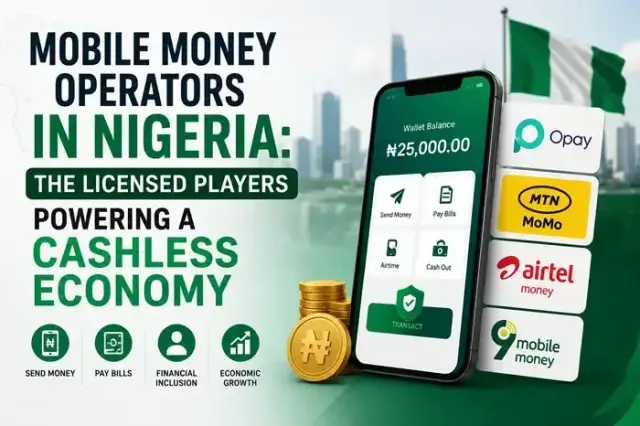
Mobile wallets have changed how Nigerians send, receive and manage money.
Today, you can open an account from your phone, receive transfers, pay electricity bills and buy airtime without entering a banking hall.
Some mobile wallets also offer debit cards, savings plans, loans and business payment tools.
However, there are now many options.
Choosing the right wallet can therefore be confusing.
Some platforms are better for frequent transfers.
Others stand out for savings, rewards, POS services or business payments.
There are also important differences between a true mobile money wallet, a payment service bank and a digital microfinance bank.
This guide looks at some of the most useful mobile wallets in Nigeria in 2026.
The list includes:
- OPay
- PalmPay
- Moniepoint
- Kuda
- MoMo PSB
- Paga
- FairMoney
- Carbon
- ALAT by Wema
- VBank
The aim is not to declare one service perfect for everybody.
Instead, this guide explains what each platform offers and who may find it useful.
What Is a Mobile Wallet?
A mobile wallet is a financial account that you can access mainly through your phone.
Depending on the provider, you may be able to use the wallet to:
- Receive money
- Transfer money
- Pay bills
- Buy airtime
- Buy mobile data
- Save money
- Request a debit card
- Withdraw cash
- Receive salary
- Borrow money
- Pay merchants
In Nigeria, the term "mobile wallet" is often used broadly.
A service such as PalmPay may operate as a mobile money platform.
MoMo operates as a Payment Service Bank.
Kuda, Moniepoint, Carbon and FairMoney operate through banking licences.
ALAT is the digital banking platform of Wema Bank.
They do not all have exactly the same regulatory structure.
However, from a user's point of view, they perform many of the same daily functions.
You open an account on your phone, fund it and use the balance for payments.
Why Are Mobile Wallets Popular in Nigeria?
Convenience is one major reason.
You do not need to visit a branch each time you want to transfer money or pay a bill.
Competition has also helped reduce fees.
Many digital financial platforms offer free transfers or lower charges under certain conditions.
Mobile wallets have also helped people in areas with limited access to traditional bank branches.
Some providers operate large agent networks.
This means customers can deposit or withdraw cash through nearby agents.
The result is a financial system where smartphones and mobile phone numbers play an increasingly important role.
In April 2026, Techpoint noted that Nigeria had more than 30 licensed mobile wallet providers.
The number of available choices makes comparison more important.
Best Mobile Wallets in Nigeria in 2026 at a Glance
| Mobile Wallet | Best For | Main Features |
|---|---|---|
| OPay | Everyday transfers and payments | Transfers, bills, airtime, savings, cards |
| PalmPay | Free transfers and rewards | Transfers, savings, cashback, bills, cards |
| Moniepoint | Reliable payments and business users | Transfers, savings, cards, bills, business banking |
| Kuda | Digital-first banking | Transfers, savings, cards, loans, investments |
| MoMo PSB | Phone-based mobile money | Wallet transfers, USSD, agents, bills, cashout |
| Paga | Mobile money and agent access | Transfers, remittance, bills, airtime, agents |
| FairMoney | Credit and everyday banking | Transfers, savings, loans, cards, bill payments |
| Carbon | Savings and credit | Transfers, bills, savings, loans, cards |
| ALAT by Wema | Full digital banking | Transfers, savings, loans, cards, voice banking |
| VBank | Digital banking and payment features | Transfers, savings, bills, QR/NFC payments, cards |
1. OPay
OPay is one of the most widely recognised digital financial platforms in Nigeria.
The platform provides a mobile account that users can fund and use for everyday transactions.
OPay describes itself as a one-stop financial service platform for:
- Payments
- Transfers
- Savings
- Loans
- Other financial services
It is licensed by the Central Bank of Nigeria, while eligible deposits are covered by the Nigeria Deposit Insurance Corporation.
What Can You Do With OPay?
OPay users can:
- Receive money
- Transfer money
- Fund their accounts
- Pay bills
- Buy airtime
- Buy mobile data
- Save money
- Use a debit card
- Access certain credit products
- Pay merchants
OPay also operates a large merchant and agent ecosystem.
Its merchant platform supports POS transactions and instant settlement into merchant wallets.
OPay Transfers
Transfers are one of OPay's main strengths.
The platform promotes fast account-to-account and bank transfers.
Its official information also highlights incentives and free transfer options.
The exact number of free transfers or promotional benefits can change.
Users should therefore check the current fee information inside the app.
OPay Debit Card
Customers can also access an OPay debit card.
This allows users to spend directly from their account where supported.
Is OPay Safe?
OPay states that it is licensed by the CBN and that eligible deposits receive NDIC insurance protection.
Users should still protect their login details.
Never disclose your PIN, password or OTP to another person.
Who Is OPay Best For?
OPay may be suitable for someone who:
- Makes many local transfers
- Pays bills frequently
- Wants easy airtime purchases
- Uses POS merchants regularly
- Wants a simple daily transaction account
For many users, OPay functions as an alternative everyday account alongside a traditional bank.
2. PalmPay
PalmPay is another major name among mobile wallets in Nigeria.
PalmPay launched in Nigeria in 2019 and has expanded from a consumer payment app into a wider financial platform.
The company says it now serves about 40 million users across its operations and provides services covering payments, savings, credit and business tools.
What Can You Do With PalmPay?
PalmPay users can access services such as:
- Money transfers
- Bill payments
- Airtime
- Data
- Savings
- Debit cards
- Credit products
- Merchant payments
- Cashback and rewards
PalmPay says it is licensed by the CBN as a Mobile Money Operator, while deposits are insured by the NDIC.
PalmPay Free Transfers
One of PalmPay's strongest selling points in 2026 is its transfer policy.
PalmPay currently advertises unlimited free transfers to Nigerian banks, with no daily free-transfer limit stated on its official transfer page.
That can make it attractive to people who make several transfers every day.
However, financial platforms can change pricing.
It is always wise to check the app before completing a transaction.
PalmPay Savings
PalmPay also provides savings products.
Its current website advertises savings returns of up to 20%, depending on the product and applicable conditions.
Interest rates can change.
Therefore, compare the current rate and withdrawal conditions before placing money into a savings plan.
PalmPay Bill Payments
PalmPay supports payments for services including:
- Airtime
- Data
- Electricity
- Television
- Transport
- Education-related services
The platform also uses rewards and cashback promotions around some bill payments.
Merchant Payments
PalmPay says its payment services are accepted at more than 600,000 local merchants.
Users can pay merchants by transferring to their PalmPay account.
Who Is PalmPay Best For?
PalmPay may be particularly useful for:
- People who transfer money frequently
- Users interested in cashback
- People who pay many bills through their phones
- Users looking for savings options
- Customers who regularly pay PalmPay merchants
3. Moniepoint
Moniepoint is widely known in Nigeria for business banking and POS services.
However, the company also offers personal banking.
Moniepoint Microfinance Bank is authorised by the CBN, and eligible deposits are insured by the NDIC.
What Can You Do With Moniepoint Personal Banking?
The Moniepoint app allows personal customers to:
- Send money
- Receive money
- Buy airtime
- Pay bills
- Save money
- Request a debit card
- Manage their account from a smartphone
The company promotes its payments network heavily.
Moniepoint currently states that its personal transfer service has a 99.9% success rate.
Moniepoint Savings
Users can create savings plans inside the app.
Moniepoint currently advertises savings returns of up to 16% per year, depending on the plan and terms.
Moniepoint Debit Card
Personal users can request a debit card.
Moniepoint says cards can be delivered within 48 hours in supported situations.
Moniepoint for Businesses
This is where Moniepoint stands out.
The company has built a strong reputation among:
- Small businesses
- Shops
- POS operators
- Merchants
- Service businesses
A person who operates both personal and business accounts may find the Moniepoint ecosystem useful.
The company recommends keeping personal and business banking separate for easier financial tracking.
Who Is Moniepoint Best For?
Moniepoint is worth considering if you:
- Run a business
- Receive many customer transfers
- Want a personal account linked to a strong business ecosystem
- Need savings features
- Prefer an app focused heavily on payment reliability
4. Kuda
Kuda is one of Nigeria's best-known digital banks.
Rather than positioning itself only as a wallet, Kuda operates as a digital-first banking platform.
Kuda Microfinance Bank holds a national microfinance banking licence from the CBN, while deposits are insured by the NDIC.
Kuda says it has more than 8 million customers.
What Can You Do With Kuda?
Kuda offers:
- Bank transfers
- Savings
- Debit cards
- Bill payments
- Airtime
- Data
- Loans
- Overdrafts
- Investments
- Business banking
Kuda Free Transfers
Kuda currently gives eligible users:
25 free transfers to other Nigerian banks every month.
Transfers between Kuda accounts are unlimited and free.
After the monthly allocation, Kuda states that it charges ₦10 for additional transfers.
Kuda Savings
Kuda provides several savings products.
The company currently advertises annual savings returns of up to 16%, depending on the product.
Kuda Cards
Customers can order:
- Physical naira cards
- Virtual cards
The platform also offers cardless payment options.
For example, users can use Pay With Bank online and Pay With USSD at supported POS terminals.
Kuda Loans
Eligible users can also access credit.
Kuda currently advertises personal loans of up to ₦150,000, subject to eligibility and its lending criteria.
Borrowers should always check the interest rate, repayment period and total repayment before accepting a loan.
Who Is Kuda Best For?
Kuda may suit people who want:
- A full digital banking experience
- Free monthly transfers
- Automated savings
- Debit and virtual cards
- Loans
- Investments
- Personal and business banking
5. MoMo PSB
MoMo Payment Service Bank, commonly called MoMo PSB, is an MTN Nigeria fintech subsidiary.
It received final CBN approval for a Payment Service Bank licence in April 2022 and formally launched in May 2022.
Unlike some app-only platforms, MoMo has a strong phone-number and agent-based approach.
What Can You Do With MoMo?
MoMo supports:
- Sending money
- Receiving money
- Buying airtime
- Buying data
- Paying bills
- Bank transfers
- Cash withdrawals
- Agent deposits
- Account statements
- Savings
- Remittances
Its official website says users can send and receive money to phone numbers and manage accounts using its mobile app.
Can You Use MoMo Without a Smartphone?
One major advantage is USSD access.
MTN users can dial:
*671#
to open and use a MoMo account.
This makes MoMo useful to people who do not want to depend entirely on a smartphone app.
MoMo Account Number
Your MTN phone number, without the first zero, can function as your MoMo account number under the current system.
This can make receiving money easier.
MoMo Agents
MoMo also benefits from a wide agent infrastructure.
The company states that it has more than 166,000 active agents and more than 10 million active users.
An agent network is particularly useful for people who frequently convert between cash and digital money.
Who Is MoMo Best For?
MoMo may suit:
- MTN users
- People who prefer USSD
- Users without smartphones
- Customers who rely on mobile money agents
- People who send money using phone numbers
- Users in areas where bank branches are limited
6. Paga
Paga is one of the older mobile payment platforms in Nigeria.
It has been part of Nigeria's mobile money market for years and continues to offer wallet, payment and agent services.
What Can You Do With Paga?
Paga customers can:
- Send money
- Receive money
- Request money
- Receive international remittances
- Pay bills
- Buy airtime
- Buy data
- Transfer money to Nigerian banks
- Withdraw through agents
Paga says users can send money to a phone number, email address or bank account.
Paga Agents
One of Paga's strengths is its agent network.
The company currently says it has more than 27,000 agents nationwide.
Agents can help customers:
- Withdraw cash
- Deposit money
- Pay bills
- Open Paga accounts
- Carry out other supported transactions
Paga USSD
Paga also supports USSD.
Users can dial:
*242#
for supported transactions without relying only on mobile data.
International Remittance
Paga also supports receiving remittances from abroad.
This gives it another use beyond domestic transfers.
Who Is Paga Best For?
Paga can be useful for:
- Users who want agent access
- People who receive remittances
- Users who prefer USSD
- Customers who pay regular bills
- People who send money using phone numbers
7. FairMoney
FairMoney began with a strong focus on digital lending.
It has since expanded into broader digital banking.
FairMoney currently offers a smart current account alongside savings, loans, cards and payments.
The company says it is licensed by the CBN, while eligible deposits are insured by the NDIC.
What Can You Do With FairMoney?
Users can access:
- Money transfers
- Savings
- Personal loans
- Credit
- Debit cards
- Bill payments
- Current account services
FairMoney says its platform serves about 20 million users worldwide.
FairMoney Loans
Credit remains one of FairMoney's major strengths.
The app provides personal lending and flexible credit products for eligible customers.
However, never choose a wallet only because it provides fast loans.
Before borrowing, check:
- Interest rate
- Fees
- Repayment period
- Late-payment penalties
- Total amount payable
FairMoney Savings
FairMoney also provides savings products.
The exact return depends on the account and current offer.
Who Is FairMoney Best For?
FairMoney may be worth considering if:
- Access to credit matters to you
- You also want normal transfers and payments
- You want savings in the same app
- You prefer one account for banking and borrowing
8. Carbon
Carbon is another Nigerian digital financial platform with roots in online lending.
Today, Carbon operates as a broader digital bank.
Carbon Microfinance Bank is licensed by the CBN, and eligible deposits are insured by the NDIC.
What Can You Do With Carbon?
Carbon supports:
- Money transfers
- Savings
- Personal loans
- Airtime purchases
- Data purchases
- Utility payments
- Cable TV payments
- Debit cards
The platform describes itself as an all-in-one app for banking, payments, spending and savings.
Carbon Transfers
Carbon currently advertises 30 free transfers each month.
This makes it another option for people who want to reduce transfer charges.
Carbon Savings
Savings are a major part of the platform.
Carbon currently offers products such as:
- Cash Vault
- Goals
- FlexSave
The company advertises returns of up to 20% on certain Cash Vault savings arrangements.
Rates and conditions can change.
Always check whether the savings are locked and when interest becomes payable.
Carbon Loans
Carbon also remains a lending platform.
Its current app listing advertises loans ranging from ₦25,000 to ₦1 million, subject to eligibility and pricing.
Loan costs can be significant.
Do not accept credit without reviewing the total repayment figure.
Who Is Carbon Best For?
Carbon may suit:
- Users interested in savings
- People who want free monthly transfers
- Customers who may need credit
- Users who want bills and banking in one app
9. ALAT by Wema
ALAT by Wema is the digital banking platform of Wema Bank.
It differs slightly from many fintech wallets because it is directly backed by a Nigerian commercial bank.
ALAT says it is used by more than 5 million Nigerians.
What Can You Do With ALAT?
ALAT provides:
- Bank transfers
- Bill payments
- Savings
- Loans
- Physical cards
- Virtual cards
- Contactless payments
- Spending tools
- Business banking
The platform is backed by Wema Bank, while deposits benefit from NDIC protection under the applicable banking framework.
ALAT Voice Banking
One of ALAT's unusual features in 2026 is SAW, which stands for Smart ALAT by Wema.
The voice assistant allows users to perform selected banking tasks using voice commands.
Examples include:
- Checking balances
- Reviewing spending
- Making transfers
- Creating savings goals
- Buying airtime
Tap and Pay
ALAT also supports NFC-based transfers between compatible devices.
Users can tap supported phones together rather than entering an account number manually.
Virtual Dollar Card
ALAT also offers a virtual dollar card for supported international payments.
This can be useful for Nigerians who pay for:
- International subscriptions
- Software
- Online services
- Foreign merchants
Always check current card funding rules and FX charges before use.
Who Is ALAT Best For?
ALAT may be a good option for someone who wants:
- Digital banking backed by a commercial bank
- Savings and loans
- Physical and virtual cards
- International online payment options
- Newer features such as voice banking
10. VBank
VBank, also known as V by VFD, is the digital banking platform of VFD Microfinance Bank.
VFD Microfinance Bank is licensed by the CBN and deposits are insured by the NDIC.
What Can You Do With VBank?
VBank offers:
- Transfers
- Savings
- Loans
- Fixed deposits
- Bill payments
- Debit cards
- Joint accounts
- QR payments
- NFC payments
VBank Rewards
VBank also operates a reward system.
Users can earn points from selected activities such as:
- Buying airtime
- Buying data
- Paying bills
- Saving
Points can be redeemed for certain benefits inside the app.
NFC and QR Payments
Another interesting feature is support for proximity payments.
VBank offers NFC and QR-based payment options.
This gives users alternatives to traditional account-number transfers.
Who Is VBank Best For?
VBank may suit people who want:
- A digital bank with broad payment features
- Savings and fixed deposits
- Reward points
- QR payments
- NFC transactions
- Joint accounts
Which Mobile Wallet Has the Most Free Transfers in Nigeria?
Free-transfer policies change frequently.
Therefore, there is no permanent winner.
As of August 2026:
PalmPay advertises unlimited free bank transfers.
Kuda currently provides 25 free transfers to other Nigerian banks every month and unlimited Kuda-to-Kuda transfers.
Carbon advertises 30 free transfers per month.
OPay also provides free-transfer benefits, although users should check the current allocation and terms inside the app.
Promotional transfer policies can change quickly.
Always confirm the fee before sending money.
Which Mobile Wallet Is Best for Savings?
Several Nigerian mobile wallets now compete heavily on savings.
As of 2026:
PalmPay advertises returns of up to 20% on selected savings products.
Carbon advertises up to 20% on certain Cash Vault products.
Kuda offers savings products with returns of up to 16%.
Moniepoint also advertises savings returns of up to 16% per year on qualifying products.
The highest advertised rate does not automatically make a product the best.
Check:
- Whether the money is locked
- Minimum balance
- Early withdrawal penalties
- How interest is calculated
- When interest is paid
- Whether the rate is promotional
Which Mobile Wallet Is Best for Business Owners?
For business users, Moniepoint and OPay are particularly strong options.
Both have large merchant and POS ecosystems.
Moniepoint has developed dedicated business banking products.
OPay also provides merchant accounts and POS services with instant transaction settlement.
Kuda also provides a separate business platform.
Kuda Business includes features such as:
- POS
- Payroll
- Expense accounts
- Invoicing
- Business registration
- Payment APIs
The best option depends on the type of business you operate.
Which Mobile Wallet Is Best Without a Smartphone?
MoMo PSB and Paga are worth considering.
MoMo supports transactions through *671#.
Paga supports *242# for selected transactions.
Both also have agent networks.
This means users can access financial services without depending entirely on a modern smartphone.
Which Mobile Wallet Is Best for Loans?
Several platforms provide credit.
These include:
- FairMoney
- Carbon
- Kuda
- PalmPay
- Moniepoint
However, there is no single "best" loan wallet.
A cheap loan for one person may be expensive for another because digital lenders often use individual risk assessments.
Before accepting any loan, look at the total amount you must repay.
Do not focus only on the amount you will receive.
For example, Carbon currently states that its loans can carry monthly interest rates between 4.5% and 30%, depending on the customer and product.
That difference can dramatically change the final cost.
Are Mobile Wallets Safe in Nigeria?
Legitimate mobile wallets can be safe when they operate under the appropriate regulatory framework.
Before depositing money, check whether the company is regulated by the Central Bank of Nigeria or operates through an appropriately licensed financial institution.
Also check whether eligible deposits receive NDIC insurance.
For example:
- OPay states that it is CBN licensed and NDIC insured.
- PalmPay states that it is CBN licensed and NDIC insured.
- Kuda is licensed by the CBN and deposits are NDIC insured.
- Moniepoint MFB is CBN regulated and NDIC insured.
- Carbon MFB is CBN licensed and NDIC insured.
- FairMoney states that it is CBN licensed and NDIC insured.
However, regulation does not remove every risk.
Customers must still protect themselves against fraud.
How to Protect Your Mobile Wallet
Never share your:
- PIN
- Password
- OTP
- Card PIN
- Verification code
A genuine financial institution should not need your OTP to "reverse" a transfer.
Also avoid installing apps from random links.
Download financial apps only from trusted sources.
Turn on:
- Biometrics
- Device lock
- Transaction PIN
- Login alerts
where available.
If your phone is stolen, contact the provider quickly.
New Mobile Banking Security Rules in 2026
The CBN introduced additional mobile banking security standards that took effect on 1 July 2026.
Under those reforms, a mobile banking app may be linked to only one device at a time.
When an app is activated on a new device, a temporary ₦20,000 transaction limit applies for the first 24 hours.
This means a user who changes phones may temporarily find that large transfers are restricted.
The measure is intended to reduce fraud linked to stolen login credentials and unauthorised device changes.
Do You Need BVN to Open a Mobile Wallet?
It depends on the provider and the account level.
Many Nigerian financial platforms use tiered KYC.
You may be able to start with basic information.
However, higher transaction limits normally require stronger identity verification.
This can include:
- BVN
- NIN
- Valid ID
- Address information
- Facial verification
For example, Moniepoint says a phone number, email and BVN can provide access to its first KYC account level.
MoMo also requires additional verification for higher wallet tiers.
Mobile Wallet vs Digital Bank: What Is the Difference?
The terms are often used interchangeably.
However, they are not exactly the same.
Mobile Money Wallet
A mobile money wallet mainly focuses on storing value and enabling payments.
PalmPay is an example of a platform operating under a Mobile Money Operator licence.
Payment Service Bank
A Payment Service Bank can provide certain financial services with a strong financial inclusion focus.
MoMo PSB is an example.
Microfinance Bank
A licensed microfinance bank can provide deposit, credit and other banking services within its regulatory framework.
Examples include:
- Kuda
- Moniepoint
- Carbon
- FairMoney
- VFD Microfinance Bank
Commercial Bank Digital Platform
Some apps are digital channels of full commercial banks.
ALAT is powered by Wema Bank.
For most customers, the practical question is less about the label and more about:
- Regulation
- Deposit protection
- Fees
- Reliability
- Services
- Customer support
Can You Keep More Than One Mobile Wallet?
Yes.
Many Nigerians use more than one.
For example, someone might use:
- OPay for everyday transfers
- PalmPay for rewards
- Moniepoint for business
- Kuda for savings
Having more than one account can also provide a backup if one network is temporarily unavailable.
However, managing too many accounts can become difficult.
Keep track of:
- Balances
- Cards
- PINs
- Savings
- Loans
- Fees
Do not borrow from several apps at the same time without understanding the repayment burden.
Can Mobile Wallets Replace Traditional Banks?
For some people, yes.
A modern digital account can handle most everyday activities.
You can:
- Receive salary
- Transfer money
- Pay bills
- Save
- Use cards
- Borrow
- Run a business
However, traditional commercial banks still offer services that some mobile platforms may not provide.
These can include:
- Large corporate banking
- Trade finance
- Letters of credit
- Foreign currency banking
- Certain international transfers
- Complex business financing
Therefore, many people use both.
How to Choose the Best Mobile Wallet in Nigeria
Do not choose a wallet because everybody around you uses it.
Look at how you actually spend money.
Check Transfer Fees
If you make 10 transfers every day, transfer pricing matters.
Check Network Reliability
A cheap transfer is not helpful if it frequently fails.
Check Savings Terms
Do not compare interest rates without reading withdrawal conditions.
Check Customer Support
Problems happen.
You need to know how easily you can reach support.
Check Agent Availability
If you handle cash regularly, agent coverage may matter.
Check Card Availability
Some users need a physical card.
Others mainly need a virtual card.
Check Regulation
Avoid unlicensed financial apps.
Check Business Features
Business owners may need more than basic transfers.
Look for:
- POS
- Statements
- Payroll
- Business accounts
- Merchant collections
- Payment links
- APIs
Mobile Wallet Comparison: Which One Is Best for You?
| If You Want... | Consider |
| Frequent free transfers | PalmPay, Kuda, Carbon, OPay |
| Strong merchant/POS network | Moniepoint, OPay |
| USSD/mobile money | MoMo PSB, Paga |
| Savings | PalmPay, Carbon, Kuda, Moniepoint |
| Personal loans | FairMoney, Carbon, Kuda |
| Business banking | Moniepoint, Kuda, OPay |
| Rewards and cashback | PalmPay, VBank |
| Digital commercial bank experience | ALAT |
| Agent access | MoMo, Paga, OPay, PalmPay |
| QR/NFC payments | VBank, ALAT, Kuda |
This does not mean each platform is limited to one feature.
Most now offer several financial services.
Frequently Asked Questions
What are the most popular mobile wallets in Nigeria?
Some of the most recognised options include OPay, PalmPay, Moniepoint, Kuda, MoMo PSB and Paga.
Other digital financial platforms include FairMoney, Carbon, ALAT and VBank.
Which mobile wallet is best in Nigeria in 2026?
There is no single best option.
PalmPay is strong for frequent free transfers and rewards.
OPay is popular for everyday transactions.
Moniepoint is particularly strong for business users.
Kuda offers a broad digital banking experience.
MoMo is useful for USSD and agent-based transactions.
The best wallet depends on how you intend to use it.
Which mobile wallet offers unlimited free transfers?
PalmPay currently advertises unlimited free transfers to Nigerian banks.
Policies may change, so confirm inside the app before transferring.
How many free transfers does Kuda offer?
Kuda currently provides 25 free transfers to other Nigerian banks each month for eligible accounts.
Kuda-to-Kuda transfers are unlimited and free.
Is OPay a bank?
OPay is a licensed financial services platform rather than a conventional commercial bank.
It operates under CBN regulation and states that eligible deposits are NDIC insured.
Is PalmPay licensed in Nigeria?
Yes.
PalmPay states that it is licensed by the CBN as a Mobile Money Operator and that deposits are insured by the NDIC.
Is Moniepoint a bank?
Yes.
Moniepoint Microfinance Bank Limited is authorised and regulated by the Central Bank of Nigeria.
Is Kuda a real bank?
Yes.
Kuda Microfinance Bank Limited holds a national microfinance banking licence from the Central Bank of Nigeria.
Can I use a mobile wallet without BVN?
Basic onboarding requirements differ between providers.
However, higher account limits and full features usually require identity verification such as BVN or NIN.
Which Nigerian wallet works with USSD?
MoMo PSB supports *671#, while Paga supports *242# for supported services.
Which mobile wallet is best for business?
Moniepoint and OPay have strong merchant and POS ecosystems.
Kuda also provides dedicated business banking tools.
Which mobile wallet is best for savings?
PalmPay and Carbon currently advertise savings returns of up to 20% on selected products.
Kuda and Moniepoint advertise rates of up to 16% on certain plans.
Always check current terms before saving.
Can I receive salary in a mobile wallet?
Many digital banks and mobile financial accounts provide Nigerian account numbers that can receive normal bank transfers.
Whether an employer will use a particular account depends on its payroll rules.
Can I use two mobile wallets at the same time?
Yes.
There is generally nothing preventing a customer from maintaining accounts with several licensed providers.
Are mobile wallets insured by NDIC?
Many licensed providers state that eligible customer deposits are insured by the NDIC.
However, the licence structure and applicable insurance limits can differ.
Check the provider's current regulatory information.
Final Takeaway
The list of mobile wallets in Nigeria in 2026 is much larger than it was only a few years ago.
Nigerians now have several strong alternatives for everyday banking and payments.
OPay remains a major choice for transfers, bills and merchant payments.
PalmPay stands out for free transfers, rewards and savings.
Moniepoint combines personal banking with one of Nigeria's strongest business payment ecosystems.
Kuda offers a broad digital banking experience with transfers, savings, cards, loans and investments.
MoMo PSB is particularly useful for phone-based banking, USSD and agent access.
Paga remains useful for transfers, remittances, bill payments and agent-based services.
FairMoney combines banking with a strong lending focus.
Carbon combines savings, payments and credit.
ALAT by Wema gives users a fully digital banking experience backed by a commercial bank.
VBank adds features such as savings, QR payments, NFC transactions and rewards.
The best option depends on what matters most to you.
If you make many transfers, compare transfer fees.
If you save regularly, compare savings products.
If you run a business, compare POS and merchant services.
If you frequently handle cash, look at agent availability.
If you borrow, pay close attention to interest and total repayment.
Most importantly, use regulated platforms.
A flashy mobile app is not enough.
Before keeping money with any financial service, confirm who operates it, what licence it uses and whether eligible deposits receive appropriate protection.
For many Nigerians, the smartest approach may not be choosing only one wallet.
It may be using two or three reliable accounts for different purposes.
One can handle daily transfers.
Another can hold savings.
A third can support business transactions.
The important thing is to understand what each service offers and choose based on your actual financial needs rather than promotions alone.


0 Comments
Be the first to comment.
Leave a comment
Replying to ·