Liberia remains one of the most important forest countries in West Africa.
The country contains a large share of the remaining Upper Guinean Forest, which supports biodiversity, rural livelihoods, food security and climate resilience. Forest resources also play an important role in the lives of communities that depend on agriculture, non-timber forest products and other natural resources.
This creates a strong need for projects that protect forests while also improving the economic opportunities available to the communities that manage them.
For Liberian NGOs, community-based organisations, conservation groups and development organisations, this creates opportunities to seek funding for:
-
Community forest management
-
Forest conservation
-
Biodiversity protection
-
Sustainable livelihoods
-
Forest governance
-
Indigenous and local community rights
-
REDD+ activities
-
Climate adaptation
-
Ecosystem restoration
-
Protected and conserved areas
-
Community monitoring
-
Sustainable agriculture
-
Non-timber forest products
-
Environmental education
-
Conservation finance
However, finding suitable funding is not always straightforward.
Some donors publish open calls.
Others accept concept notes throughout the year.
Some work through accredited international organisations or government partners.
Others use country programmes and regional funding mechanisms.
This article identifies 10 donor and development partners and funding routes that are relevant to sustainable community forest management in Liberia for 2026/2027, with particular attention to opportunities that can support community-led conservation.
Important Funding Status for Liberia in 2026
Before applying, applicants should understand the difference between an open call, a rolling funding mechanism and a funding route that requires an intermediary or accredited partner.
As of 23 September 2026, the most clearly open direct opportunities include the Rainforest Trust application route, the Global EbA Fund's upcoming 2026 calls, Friends of Liberia's rolling small grants and the 2027 Whitley Awards.
Other major programmes, including the Critical Ecosystem Partnership Fund and Darwin Initiative, have already closed their initial 2026 application stages. They remain important donors to monitor for the next funding cycle or for invited second-stage applications. For example, CEPF's 2026 Guinean Forests large-grant call included Liberia and offered grants of $50,000 to $250,000, but its deadline was 11 May 2026.
Therefore, organisations should not treat every donor in this list as an open application today.
The list instead covers the most relevant current and near-term funding routes for 2026/2027.
Top Donor and Development Partners for Sustainable Community Forest Management in Liberia
| No. | Donor / Partner | Relevant Funding Route | Funding | Liberia Status |
|---|---|---|---|---|
| 1 | Rainforest Trust | Concept Notes and Conservation Awards | Average feasibility award around $10,000; larger awards available | Open / Rolling |
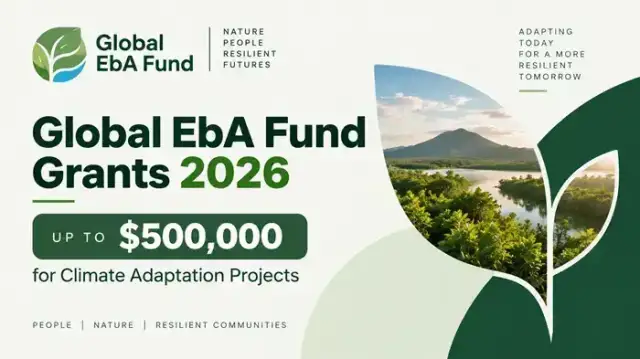
| 2 | Global EbA Fund | Small and Medium-Size Grants | Up to $250,000 / $500,000 | 2026 Calls Open Soon |
| 3 | Friends of Liberia | Small Grants Programme | Up to $3,000 | Open / Rolling |
| 4 | Whitley Fund for Nature | 2027 Whitley Award | £50,000 | Open until 30 Oct. 2026 |
| 5 | Fund for Innovation in Development | Open Innovation Funding | Funding varies by stage | Open / Year-round |
| 6 | Green Climate Fund | Country and Accredited-Entity Projects | Project-dependent | Concept route / Partner-led |
| 7 | Adaptation Fund | Locally Led Adaptation and Country Projects | Project-dependent | Concept/proposal route |
| 8 | Global Environment Facility | GEF-SGP and GEF country programmes | Programme-dependent | Active Liberia funding mechanism |
| 9 | Critical Ecosystem Partnership Fund | Guinean Forests of West Africa grants | $50,000–$250,000+ | Monitor next call |
| 10 | Darwin Initiative | Main / Extra / Capability & Capacity | £75,000–£1 million depending on scheme | Monitor / 2027 pipeline |
1. Rainforest Trust
Funding status: Open and accepting concept notes
For organisations working directly on forest conservation in Liberia, Rainforest Trust is one of the most relevant funding partners to investigate.
Rainforest Trust supports non-profit organisations, Indigenous Peoples and communities working to establish or expand protected and conserved areas in tropical and subtropical regions.
Its funding can support projects that protect threatened species, high-integrity tropical forests and ecosystems that have important climate value. The organisation also looks for projects that involve local communities and have a credible long-term management structure.
This is particularly relevant to Liberia because Rainforest Trust already has established relationships with Liberian conservation organisations.
Its partners include the Society for the Conservation of Nature of Liberia (SCNL) and the Save My Future Foundation (SAMFU). Rainforest Trust has also worked with Liberian partners on protection of important forest landscapes.
What Can Be Funded?
Rainforest Trust offers two broad types of support.
The first is a Feasibility Award.
These awards can help organisations investigate whether a proposed protected or conserved area can realistically be established. The average feasibility award is around $10,000, although exceptional awards can exceed $20,000.
The second category is a Protected or Conserved Area Creation Award.
There is no fixed maximum for these awards. Projects are assessed individually.
The organisation can support work involving land protection, community conservation, protected-area creation and other recognised conservation mechanisms.
How to Apply
Rainforest Trust has an important feature for Liberian NGOs.
Concept notes are accepted throughout the year.
The organisation says concept notes are normally reviewed within one to two months. Successful applicants can then be invited to develop a detailed application.
For awards of $250,000 or more, Rainforest Trust recommends submitting the concept note four months before its application deadlines.
The next major deadlines are:
1 October
1 March
1 July
The organisation also states that smaller awards can be submitted on a rolling basis.
Who Can Apply?
Applicants must generally be legally registered NGOs authorised to operate in the country where the project will take place.
Projects should also demonstrate support from relevant government institutions and Indigenous Peoples or local communities.
For community forest projects, this means that a proposal should not simply describe tree planting.
It should explain how the community will participate in governance, management, monitoring and long-term conservation.
2. Global EbA Fund
Funding status: 2026 calls opening in September and October
The Global EbA Fund is another strong opportunity for organisations working at the intersection of forests, climate adaptation, biodiversity and community resilience.
The Fund is implemented by IUCN and UNEP and supported through the International Climate Initiative.
Its current 2026 funding round contains two grant windows.
The Small-Size Grant window offers up to:
US$250,000
for projects lasting up to 24 months.
Applications are scheduled to open on:
28 September 2026
and close on:
26 October 2026.
The Medium-Size Grant window offers up to:
US$500,000
for projects lasting up to 24 months.
Its submission window is:
12 October to 16 November 2026.
Is Liberia Eligible?
The current Small-Size Grant call says its primary geographic focus is on ODA-eligible Small Island Developing States and Least Developed Countries.
However, applications from other ODA-eligible countries can be considered where the proposal demonstrates exceptional ambition and strong opportunities for scaling.
Liberia is an ODA-eligible least developed country.
Therefore, a Liberian application may be relevant, but applicants should read the current call carefully and demonstrate why the project has strong potential to scale.
What Does the Fund Support?
The current call focuses on overcoming barriers to scaling ecosystem-based adaptation.
Relevant themes include:
-
Institutional capacity
-
Technical capacity
-
Data and evidence
-
Learning networks
-
Investment readiness
-
Climate adaptation
-
Ecosystem protection
-
Innovative financing
For a community forest project, the proposal should therefore connect forest management to climate resilience.
For example, an organisation could develop a project that helps communities protect forest ecosystems while strengthening livelihoods and reducing vulnerability to climate impacts.
The Fund accepts applications from NGOs, community organisations, Indigenous Peoples' organisations, universities, research institutions, private-sector companies and eligible consortia.
3. Friends of Liberia Small Grants Programme
Funding status: Open and rolling
For smaller Liberian organisations, Friends of Liberia (FOL) provides a more accessible funding route.
Its Small Grants Programme provides grants of up to:
US$3,000
to registered nonprofit organisations and NGOs operating in Liberia.
Applications can be submitted:
Any time of the year.
They are reviewed on a rolling basis during quarterly review cycles.
The programme supports community-led initiatives in areas including environmental sustainability, community development, health, education and economic development.
Environmental improvement is specifically listed among the programme's focus areas.
Why It Matters for Community Forestry
A $3,000 grant will not finance a large forest landscape programme.
However, it could support a smaller community project.
For example, an organisation could potentially develop a pilot involving:
-
Community forest mapping
-
Environmental education
-
Forest governance workshops
-
Community monitoring
-
Sustainable livelihood training
-
Awareness campaigns
-
Documentation
-
Small conservation activities
The programme gives preference to Liberian-led organisations with experience implementing community projects.
This makes it especially relevant to small local NGOs.
4. Whitley Fund for Nature
Funding status: 2027 applications open
The Whitley Fund for Nature has opened applications for its:
2027 Whitley Awards.
Each award provides:
£50,000
in project funding for one year.
The deadline is:
30 October 2026 at 23:59 GMT.
The award is designed for grassroots conservation leaders who are already implementing proven conservation solutions.
This is important because the Whitley Award is not simply a general organisational grant.
The applicant needs to demonstrate practical conservation work that is already producing results.
Who Can Apply?
The programme is designed for mid-career conservation leaders who are nationals of the country where they work.
Projects must involve communities and deliver practical conservation action based on sound evidence.
Therefore, a Liberian conservation professional leading a successful community forest programme could potentially be a strong fit.
The funding can support efforts to scale an existing solution rather than simply test an unproven idea.
The award also provides international recognition, communications support, networking and access to future funding opportunities.
5. Fund for Innovation in Development
Funding status: Open year-round
The Fund for Innovation in Development (FID) operates a continuously open funding mechanism for innovative projects addressing poverty and inequality.
The programme supports projects in low- and middle-income countries.
Liberia falls within the eligible country group.
FID does not impose a narrow sector restriction. It can support innovations at different stages, from early prototypes and pilots to impact evaluation and scale-up.
Why Is FID Relevant to Forest Management?
FID is not a forest-specific donor.
However, that does not mean a forest project cannot fit.
The strongest proposal would connect forest conservation with a measurable development problem.
For example:
Can financial incentives encourage communities to protect forests while improving household income?
This is not just a conservation question.
It is also a poverty and development question.
FID has already supported a Liberia-based project examining financial compensation for protecting community-held forests.
The project, led by Parley Liberia with an international research team, runs from June 2025 through December 2027 and is testing financial incentives linked to forest conservation and community governance.
This provides a strong indication that innovative community forest-finance models can fit within FID's development approach.
6. Green Climate Fund
Funding status: Active Liberia funding route through accredited partners
The Green Climate Fund (GCF) is one of the major international climate-finance institutions relevant to Liberia.
However, it is important to understand how GCF funding works.
A local NGO generally cannot simply send a concept note directly to the GCF and expect it to be assessed like a small NGO grant.
Projects normally move through the GCF's accredited entities and country programming structures.
Liberia already has an established relationship with the GCF.
The GCF's Liberia country page lists several projects and documents, including climate resilience work and a project focused on inclusive agriculture and protecting forests.
The GCF has also supported Liberia's climate-planning and country-programming processes.
What Could a Community Forest Proposal Look Like?
A larger project could combine:
-
Forest conservation
-
Climate adaptation
-
Sustainable agriculture
-
Community livelihoods
-
Ecosystem restoration
-
Climate information
-
Resilient value chains
The project would need to fit Liberia's national climate priorities.
For a local NGO, the practical route is therefore to develop the concept and seek partnership with an accredited entity or relevant national institution.
This is a development-partner route, rather than a simple small-grant application.
7. Adaptation Fund
Funding status: Active concept/proposal mechanism
The Adaptation Fund provides another potential route for projects connecting forest ecosystems with climate adaptation.
Its Locally Led Adaptation funding mechanism is particularly relevant to community-level projects.
The Fund provides application templates for pre-concepts, concepts and fully developed proposals.
For single-country LLA grants, the submission requires a signed letter of endorsement from the country's designated authority.
This means that an NGO cannot necessarily approach the Fund independently.
The project must fit the Fund's institutional process.
Why Is It Relevant to Liberia?
Forest communities face climate-related challenges affecting:
-
Agriculture
-
Water
-
Food security
-
Livelihoods
-
Biodiversity
-
Land degradation
A forest management project can therefore be designed as a climate adaptation programme rather than as conservation alone.
The Adaptation Fund's regional LLA mechanism also allows proposals to be submitted through accredited regional or multilateral implementing entities.
Liberia has previously appeared in Adaptation Fund processes, including approved proposals and concept-note decisions.
8. Global Environment Facility
Funding status: Active Liberia funding mechanism; monitor country calls
The Global Environment Facility (GEF) is one of the most important environmental financing mechanisms for Liberia.
GEF funding covers areas including:
-
Biodiversity
-
Climate change
-
Land degradation
-
Sustainable forest management
-
International waters
-
Chemicals and waste
The GEF's Small Grants Programme is implemented by UNDP and is designed to support civil society and community-level environmental initiatives.
Liberia has participated in the GEF Small Grants Programme since 2009.
According to UNDP Liberia, the programme has supported grassroots environmental initiatives involving biodiversity conservation, climate mitigation and adaptation, sustainable land and forest management and community development. More than $3 million in grants has been distributed through the programme in Liberia.
Liberia also validated its Phase 8 GEF-SGP Country Programme Strategy in 2025.
What Should NGOs Do?
The key point is that organisations should monitor the Liberia country programme rather than assume that every GEF-SGP call published elsewhere applies to Liberia.
For example, a 2026 GEF-SGP call in Ghana specifically targeted Ghanaian organisations and therefore cannot be presented as a Liberia opportunity.
A Liberian organisation should instead follow UNDP Liberia and the national GEF-SGP process for announcements applicable to Liberia.
9. Critical Ecosystem Partnership Fund
Funding status: Monitor next call
The Critical Ecosystem Partnership Fund (CEPF) is particularly relevant to Liberia because the country forms part of the:
Guinean Forests of West Africa Biodiversity Hotspot.
This is one of the most important conservation funding mechanisms for organisations working in the region.
In 2026, CEPF opened a large-grant call for the Guinean Forests of West Africa.
Eligible countries included:
-
Liberia
-
Ghana
-
Côte d'Ivoire
-
Cameroon
-
Equatorial Guinea
-
São Tomé and Príncipe
The grant size was:
US$50,000 to US$250,000.
The application deadline was:
11 May 2026.
CEPF also opened a separate small-grant call for organisations in Liberia and other countries across the hotspot.
That call offered grants of up to:
US$50,000
and accepted applications from NGOs, community groups, private enterprises, independent public institutions and other civil society organisations.
The deadline was:
31 August 2026.
These 2026 calls are now closed.
However, CEPF should remain high on the funding watchlist for 2027 because its geographical and thematic focus is directly connected to Liberia's forests.
A Liberian organisation should therefore prepare its project concept before the next call opens.
10. Darwin Initiative
Funding status: 2026 first-stage applications closed; 2027 projects in pipeline
The Darwin Initiative is another major biodiversity and development fund worth monitoring.
It supports projects that combine biodiversity conservation with poverty reduction.
The 2026 Main scheme offered grants ranging from:
£200,000 to £1 million.
Projects can run for between two and five years.
The 2026 Main call opened in May.
The first-stage deadline was:
20 July 2026.
The second stage is available only to invited applicants and has a deadline of:
30 November 2026.
Successful projects are expected to begin from:
1 April 2027.
The Darwin Initiative also has Extra and Capability & Capacity funding schemes.
The Capability & Capacity scheme offered between:
£75,000 and £250,000
for projects focused on strengthening local and national organisations working on biodiversity conservation and poverty reduction.
The first-stage application period for these 2026 schemes has already closed.
However, the programme remains important for organisations preparing for future rounds and for partnerships that may be formed around the 2027 implementation pipeline.
What Does Sustainable Community Forest Management Mean?
Sustainable community forest management means allowing communities to participate meaningfully in the governance and use of forests while protecting the ecological functions of those forests for the future.
It is different from simply creating a protected area.
A community forest project may involve:
-
Community forest governance
-
Participatory mapping
-
Forest boundary demarcation
-
Sustainable harvesting
-
Non-timber forest products
-
Agroforestry
-
Forest restoration
-
Community patrols
-
Biodiversity monitoring
-
Fire management
-
Alternative livelihoods
-
Women's participation
-
Youth participation
-
Indigenous and local knowledge
-
Conservation finance
A good project should therefore explain both:
How the forest will be protected
and:
How the community will benefit.
Why Community Forest Management Matters in Liberia
Forest conservation cannot depend entirely on government enforcement.
Many communities live close to forests and depend on them for their livelihoods.
They often have valuable knowledge about:
-
Forest species
-
Seasonal changes
-
Traditional resource use
-
Wildlife
-
Farming
-
Medicinal plants
-
Water sources
Community involvement can therefore improve the quality and sustainability of conservation programmes.
Liberia's own forest-management framework recognises community forestry as an important part of the country's forest sector.
Recent analysis has also highlighted challenges affecting the effectiveness of community forestry in Liberia, including governance and implementation issues.
This creates an important funding opportunity for projects that strengthen community institutions rather than simply finance short-term conservation activities.
What Donors Want to See in a Liberia Forest Proposal
A strong proposal should start with a clearly defined problem.
Do not simply write:
"Liberia is losing its forests."
Explain what is happening in the target landscape.
For example, the problem could involve:
-
Unsustainable timber extraction
-
Agricultural expansion
-
Weak community governance
-
Illegal logging
-
Loss of wildlife habitat
-
Lack of alternative livelihoods
-
Forest fires
-
Weak monitoring
-
Insecure land rights
-
Poor access to conservation finance
Then explain what the project will do.
Build the Proposal Around Communities
Donors increasingly want to see local ownership.
A community forest project should therefore identify:
-
Target communities
-
Community leadership structures
-
Local institutions
-
Women's groups
-
Youth groups
-
Traditional authorities
-
Government partners
-
Conservation organisations
Explain how these groups will participate in decision-making.
Do not describe communities only as beneficiaries.
Show how they will become part of the management system.
Include a Livelihood Component
Forest protection can become difficult when communities have few economic alternatives.
A good project can therefore combine conservation with livelihood development.
Potential activities include:
-
Agroforestry
-
Beekeeping
-
Sustainable agriculture
-
Non-timber forest products
-
Ecotourism
-
Community enterprises
-
Sustainable charcoal alternatives
-
Small-scale processing
-
Conservation-linked employment
The exact activity should be based on the local context.
Do not add livelihood activities simply to make the proposal appear comprehensive.
Include a Forest Governance Component
Governance is often just as important as conservation.
A proposal could address:
-
Community forest committees
-
Local bylaws
-
Participatory mapping
-
Resource-use agreements
-
Monitoring systems
-
Conflict resolution
-
Government-community coordination
-
Transparency
-
Benefit sharing
This can make the project more sustainable after donor funding ends.
Include Measurable Results
Donors want to know what will change.
Instead of writing:
"The project will improve forest conservation."
Use measurable targets.
For example:
1,000 hectares placed under improved community management.
10 communities trained in forest governance.
50 community forest monitors trained.
500 households supported with sustainable livelihood activities.
20% reduction in illegal forest activities in target areas.
The figures must be based on realistic assessments.
Do not invent numbers simply to make a proposal look ambitious.
Sustainable Community Forest Management and Climate Finance
Forest conservation increasingly intersects with climate finance.
Forests store carbon.
They also help communities adapt to climate impacts.
This creates opportunities to connect community forestry with:
-
Climate adaptation
-
Mitigation
-
REDD+
-
Ecosystem-based adaptation
-
Nature-based solutions
-
Conservation finance
-
Carbon markets
However, organisations should avoid making unsupported carbon-credit claims.
A carbon project requires credible measurement, reporting, verification and legal arrangements.
A small community NGO should therefore focus first on developing a sound forest-management model.
Sustainable Community Forest Management and Biodiversity
Liberia's forests are important for biodiversity.
The country contains part of the Upper Guinean Forest, a globally important biodiversity region.
The CEPF's Guinean Forests of West Africa programme specifically identifies Liberia as an eligible country for biodiversity conservation funding.
A biodiversity-focused proposal can therefore target:
-
Threatened species
-
Key Biodiversity Areas
-
Forest elephants
-
Pygmy hippos
-
Primates
-
Endemic species
-
Wildlife corridors
-
Critical habitats
The project should clearly connect the conservation target with the proposed community activities.
Sustainable Community Forest Management and Women's Participation
Women often play important roles in rural economies and natural-resource use.
A strong proposal should explain how women will participate in:
-
Forest governance
-
Livelihood development
-
Decision-making
-
Monitoring
-
Training
-
Community enterprises
This should be practical.
Do not simply add "women and youth" to a proposal without explaining their actual roles.
Sustainable Community Forest Management and Youth
Young people can contribute to community forest projects through:
-
Forest monitoring
-
Mapping
-
Digital data collection
-
Environmental education
-
Eco-tourism
-
Nursery management
-
Agroforestry
-
Social enterprise
-
Communications
Youth participation can also create employment opportunities linked to conservation.
Documents a Liberian NGO Should Prepare
Before applying for funding, organisations should prepare a basic donor-readiness file.
It should include:
-
Certificate of registration
-
Organisational profile
-
Governing documents
-
Board information
-
Financial records
-
Bank information
-
Previous project reports
-
Previous donor references
-
Staff CVs
-
Safeguarding policies
-
Environmental policies
-
Gender policy
-
Anti-fraud policy
-
Procurement policy
-
Monitoring and evaluation framework
The exact documents required will vary by donor.
However, having these documents ready can save significant time when a call opens.
How to Prepare a Forest Funding Concept Note
A good concept note does not need to be unnecessarily complicated.
Start with the problem.
Explain where the problem is occurring and who is affected.
Then introduce your solution.
Explain what you will do, who will participate and what you expect to change.
A strong concept note should normally answer:
What is the problem?
Where is it happening?
Who is affected?
Why does it matter?
What will you do?
Who will implement it?
Who will benefit?
What will change?
How much will it cost?
How will the results continue after the grant?
How to Make a Liberia Forest Proposal More Competitive
The proposal should fit the donor.
Do not write one generic proposal and send it to every organisation.
A Rainforest Trust proposal should emphasise protected or conserved areas.
A Global EbA Fund proposal should explain the ecosystem-based adaptation challenge and how the intervention can scale.
A Whitley Award application should demonstrate the conservation leader's track record and a proven community-based solution.
An FID application should clearly explain the innovation and development impact.
A GCF or Adaptation Fund concept should connect the project to climate priorities and the appropriate national or accredited-entity process.
The same forest project can therefore require different framing for different funders.
Common Mistakes to Avoid
One common mistake is applying to every donor without checking eligibility.
Another is treating a large climate fund like a small NGO grant.
The application route matters.
A third mistake is designing a project around donor language rather than community needs.
The project should begin with a real problem.
Another mistake is making forest conservation the only outcome.
Donors may want to see how the project affects:
-
Livelihoods
-
Biodiversity
-
Climate resilience
-
Governance
-
Gender equality
-
Community institutions
Finally, organisations should avoid claiming that a donor is currently accepting applications when the call has already closed.
This is especially important in 2026 because several forest-related calls for Liberia have already closed during the year.
Recommended Funding Strategy for Liberian NGOs
A good strategy is to divide your funding search into three levels.
Level One: Apply Now
Start with opportunities that are currently accepting applications.
For September 2026, this includes:
Rainforest Trust
Friends of Liberia
Whitley Fund for Nature
and the upcoming:
Global EbA Fund
calls.
Level Two: Build a Concept for the Next Window
Prepare concepts for:
CEPF
Darwin Initiative
and:
GEF-SGP Liberia.
Do not wait for the next call before developing the idea.
Level Three: Build Institutional Partnerships
For larger climate projects, explore:
Green Climate Fund
and:
Adaptation Fund.
These mechanisms generally require accredited or institutional partners.
Frequently Asked Questions
Which donor is currently accepting forest conservation concept notes in Liberia?
Rainforest Trust currently accepts concept notes on a rolling basis for qualifying protected and conserved-area projects. Its concept notes can be submitted throughout the year.
How much can Rainforest Trust provide?
Feasibility Awards average around $10,000, while Protected or Conserved Area Creation Awards have no fixed maximum and are assessed individually.
Does Friends of Liberia fund environmental projects?
Yes. Its Small Grants Programme includes environmental sustainability and environmental improvement among its eligible areas. Grants are up to $3,000 and applications are accepted throughout the year.
Can a Liberian NGO apply to the Global EbA Fund?
Potentially, yes. Liberia is an ODA-eligible country, but applicants must satisfy the specific eligibility and geographic conditions of the 2026 call. The current small-grant call gives primary geographic emphasis to SIDS and LDCs and says other ODA-eligible countries can be considered where there is exceptional ambition and strong scaling potential.
How much does the Global EbA Fund offer?
The current small-size grant window offers up to $250,000. The medium-size window offers up to $500,000.
When does the Global EbA Fund small-grant call open?
The submission window runs from:
28 September to 26 October 2026.
When does the medium-size call open?
The medium-size grant submission window runs from:
12 October to 16 November 2026.
Can an individual apply for the Whitley Award?
The Whitley Award is designed for conservation leaders rather than ordinary organisational grant applications. Applicants must meet the programme's eligibility conditions and lead a community-based conservation project.
How much is the 2027 Whitley Award?
Each award provides:
£50,000 in project funding for one year.
When is the Whitley Award deadline?
Applications for the 2027 Whitley Awards close on:
30 October 2026 at 23:59 GMT.
Is CEPF currently accepting applications from Liberia?
The major 2026 CEPF Guinean Forests calls identified in this research have closed. The large-grant deadline was 11 May 2026, while the small-grant deadline was 31 August 2026.
However, CEPF remains an important donor to monitor because Liberia is part of the Guinean Forests of West Africa Biodiversity Hotspot.
Does the GEF fund community forest management in Liberia?
Yes. The GEF Small Grants Programme has supported Liberia since 2009, including work involving biodiversity conservation, climate change, sustainable land and forest management and community development.
Can a small Liberian NGO apply directly to the Green Climate Fund?
Not in the same way it would apply to a small NGO grant.
GCF projects generally move through accredited entities and national programming structures.
A local NGO should therefore explore partnership opportunities with an accredited entity or relevant Liberian institution.
Can forest conservation be presented as a climate project?
Yes, where there is a genuine climate link.
Forest projects can address climate mitigation, adaptation, ecosystem resilience and climate-related livelihood risks.
The climate argument must be supported by the project's actual activities and expected results.
Final Takeaway
There is growing funding potential for sustainable community forest management in Liberia, but organisations need to understand how different donors operate.
The most immediately useful routes in late 2026 include Rainforest Trust, Friends of Liberia, the Whitley Fund for Nature and the upcoming Global EbA Fund calls.
Rainforest Trust is particularly relevant for protected and conserved areas because it accepts concept notes throughout the year and already works with conservation organisations in Liberia.
Friends of Liberia provides a smaller but accessible funding route for Liberian nonprofits, with grants of up to $3,000 and rolling applications.
The Whitley Fund for Nature provides a larger £50,000 award for eligible conservation leaders and has an open 2027 application window closing on 30 October 2026.
The Global EbA Fund is also worth preparing for immediately. Its 2026 calls provide up to $250,000 for small-size projects and up to $500,000 for medium-size projects, with submission windows beginning in September and October 2026.
At the same time, organisations should keep GEF, CEPF and Darwin Initiative on their 2027 funding calendars. These programmes have strong relevance to Liberia's forests, but some of their 2026 application windows have already closed.
For larger climate projects, the Green Climate Fund and Adaptation Fund offer another route. However, these mechanisms usually require national institutions, accredited entities or other approved partners.
The most important lesson is to prepare before the funding window opens.
A strong Liberia forest project should have a clear community role, measurable conservation results, realistic livelihood benefits and a credible plan for long-term management.
It should also explain why the forest matters to the people who depend on it.
That is the foundation on which a strong concept note can be built for 2026 and 2027.


0 Comments
Be the first to comment.
Leave a comment
Replying to ·