Raising capital in 2026 looks different than it did even two years ago. Venture rounds are taking longer to close, valuations are more disciplined, and founders are increasingly asking a question that used to be a footnote: do we actually need to sell equity to get this milestone funded?
Non-dilutive grant funding — money you don't pay back and don't give up ownership for — has quietly become one of the most important levers in early-stage tech financing. In the United States alone, federal agencies distribute several billion dollars a year to small technology companies through the SBIR/STTR system. In Europe, the EIC Accelerator is deploying hundreds of millions of euros into deep-tech scale-ups. And 2026 has been an unusually eventful year for this world: a lapse in congressional authorization froze several agencies' pipelines in late 2025, a reauthorization bill signed in April 2026 restarted the clock, and by mid-year NSF, DARPA, and NIH were all reopening their doors with new rules, new award tiers, and tighter deadlines.
This guide walks through the five grant programs most worth an emerging tech founder's attention this year, plus the eligibility patterns, deadlines, and strategic considerations that sit around them.
Why 2026 Is a Strange, Important Year for Startup Grants
A quick bit of context matters before diving into the programs themselves. The legislative authority behind the SBIR (Small Business Innovation Research) and STTR (Small Business Technology Transfer) programs — the backbone of U.S. non-dilutive tech funding — expired on October 1, 2025. That triggered a months-long freeze: NIH pulled every active solicitation, NSF paused its pipeline, and agencies were barred from issuing new awards until Congress acted. On April 13, 2026, the President signed bipartisan legislation reauthorizing both programs through September 30, 2031, and agencies spent the following months rebuilding their solicitation calendars — often with new rules attached, including mandatory foreign-ownership risk screening and, in several agencies, a brand-new "Strategic Breakthrough" award tier worth up to $30 million for follow-on scaling.
The practical upshot for founders: the reopening has created both a backlog of demand and a genuine window of opportunity, since the applicant pool briefly thinned during the freeze. Timing your application to these reopened windows matters more this year than in a typical cycle.
1. SBIR/STTR — "America's Seed Fund" (Federal, 11 Agencies)
If you take away only one program from this list, make it this one. SBIR and STTR together move roughly $4 billion a year in non-dilutive funding across eleven federal agencies, and no equity or repayment is required in exchange.
How it works: Each participating agency — Department of Defense, NIH, NSF, NASA, DOE, USDA, DHS, NIST, EPA, DOT, and the Department of Education — runs its own solicitation calendar, topic list, and review process, but the phase structure is shared:
- Phase I funds feasibility and proof-of-concept work. The 2026 statutory cap sits at $314,363, though several agencies (NIH, DARPA) have topic-specific waivers that push that above $400,000.
- Phase II funds prototype development and typically runs up to roughly $2.1–2.5 million, again with waiver topics reaching higher.
- Direct-to-Phase II and Fast-Track options let companies skip or combine phases when they already have strong preliminary data.
- New for 2026: several agencies are rolling out Strategic Breakthrough Award tiers offering up to $30 million over 48 months for companies that have already proven out a Phase II technology and need capital to scale, generally with a 100% private matching-fund requirement.
Eligibility: You must be a U.S.-based, for-profit small business, majority-owned (typically 50–51%+) by U.S. citizens or permanent residents, with the principal investigator primarily employed by the company. STTR additionally requires a formal research partnership with a university or nonprofit research institution, which performs at least 30% of the work.
What's new and worth knowing: Every 2026 application now goes through mandatory foreign-risk screening covering ownership structure, patent history, employee backgrounds, and financial ties to countries of concern — a direct response to national-security concerns raised during the reauthorization debate. Build extra lead time into your application process to gather this documentation.
Strategic tip: Because eleven agencies run this program independently, the real skill isn't knowing "SBIR exists" — it's picking the agency whose published topics match your technology and mission story most cleanly. A cybersecurity startup pitching NIH will struggle; the same company pitching DoD or DHS won't.
2. NSF SBIR/STTR — The 2026 Deep-Tech Relaunch
The National Science Foundation's version of SBIR/STTR deserves its own entry this year because of how consequential its 2026 relaunch has been. After sitting dormant for months during the authorization freeze, NSF restarted the program on May 31, 2026, with a $250 million FY26 commitment — one of the more dramatic single-agency reopenings of the year.
Funding structure:
- Phase I: up to $305,000 for 6–18 months of feasibility work.
- Phase II: up to $1.25 million over roughly 24 months for prototype development.
- Fast-Track (combined Phase I/II): up to $1.555 million.
- A new $40 million pilot for scientific instrumentation (solicitation NSF 26-511), aimed specifically at hardware and lab-instrument startups.
- A new Strategic Breakthrough Awards tier offering up to roughly $30 million for post-Phase II growth, arriving as first solicitations are expected in late 2026 or early 2027.
The gate that matters — Project Pitch: Before any full Phase I proposal, NSF requires a "Project Pitch" — a short, mandatory screening submission. These reopened on June 2, 2026, capped at two per company annually. Full-proposal deadlines under solicitation NSF 26-510 land on July 27, 2026, then November 4, 2026, then the first Wednesday of November and first Thursday of March in subsequent cycles.
Why founders like it: NSF explicitly funds "high-risk, high-impact technologies requiring substantial R&D" rather than incremental product engineering, which makes it a strong fit for genuinely novel deep-tech (AI infrastructure, materials science, quantum, biotech tooling) rather than app-layer SaaS. Historical Phase I award rates run 10–20%, and between 2016 and 2025 NSF's program put over $2 billion into 1,600+ startups that went on to raise roughly $36 billion in private follow-on capital — an 18-to-1 leverage ratio that the agency cites heavily in its own defense of the program.
Practical advice: Get your Project Pitch in during the first week a window opens rather than waiting until the deadline. Founders who submit early get feedback faster and have more runway to strengthen a full proposal if invited.
3. DARPA SBIR/STTR — Dual-Use Deep Tech for Defense and Commercial Markets
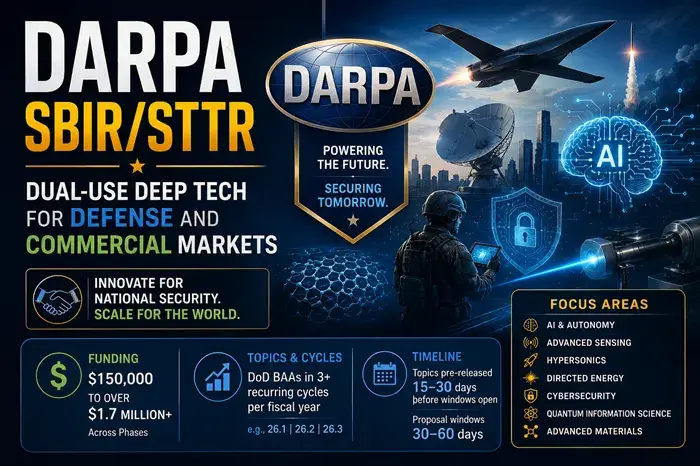
DARPA's small business program sits inside the broader Department of Defense SBIR/STTR system but functions almost like its own product line, funding startups building technology that's useful both to national security and to commercial markets — AI and autonomy, advanced sensing, hypersonics, directed energy, cybersecurity, quantum information science, and advanced materials.
Funding: Awards commonly range from $150,000 to over $1.7 million across phases, with some direct-to-Phase-II topics reaching $2–3 million. DoD releases its Broad Agency Announcements (BAAs) in three or more recurring cycles per fiscal year (e.g., 26.1, 26.2, 26.3), with topics pre-released 15–30 days before submission windows open, followed by 30–60 day proposal windows.
Eligibility: Standard SBIR eligibility applies (U.S.-based, majority U.S.-owned small business), but DARPA proposals live or die on the strength of their dual-use narrative. A generic commercialization plan that doesn't include a credible defense-side pilot pathway consistently scores poorly.
What's distinctive: DARPA has increasingly narrowed toward Direct-to-Phase II topic slots rather than the traditional Phase I → Phase II ladder, meaning startups with existing prototypes and data can skip straight to larger checks — but the bar for evidence is correspondingly higher. Recent 2026 topics have included funding for machine-learning-plus-LLM fusion systems for large-scale statistical analysis, and geopolitical forecasting engines built on multilingual signal processing, both with compressed four-week application windows.
Strategic tip: Because DARPA topics are narrow and specific (not broad calls like NSF's), the winning move is matching your existing technology to a topic almost exactly — this is not the place to stretch a loosely related product into a defense narrative.
4. NIH SBIR/STTR — Biotech, Health Tech, and Medical Device Innovation
For founders building in biotech, digital health, diagnostics, or medical devices, NIH runs the largest and most specialized federal grant pipeline in that space — and 2026 has been a rollercoaster year for it. NIH's SBIR/STTR NOFOs were formally expired on November 17, 2025, leaving zero active solicitations for the first time in a decade, a gap that persisted through most of the year while the agency worked through new reauthorization-driven implementation guidance.
The 2026 reset: NIH reposted its omnibus solicitations, with a first standard deadline of September 8, 2026 (pushed from September 5 because of the Labor Day holiday). The reopened structure includes:
- Parent SBIR / Parent STTR (Clinical Trial Optional): accepting Phase I, Phase II, Direct-to-Phase II, and Fast-Track applications.
- Phase IIB Strategic Breakthrough Award: a new post-Phase II growth tier for existing awardees, with awards reportedly reaching up to $30 million.
- SBIR/STTR Commercialization Readiness Pilot (CRP): additional support for Phase II awardees moving toward market.
- A forecasted Small Business Transition Grant for New Entrepreneurs, expected to open around January 2027.
Award sizes: Phase I funding typically runs up to roughly $323,000, and Phase II up to about $2.15 million, with waiver topics reaching $700,000 and $3 million respectively on high-priority areas.
Eligibility: Standard SBIR/STTR ownership and PI-employment rules apply; STTR applicants must have a formal research-institution partner performing a defined share of the work.
Why this matters strategically: The long hiatus means NIH is walking into its September 2026 deadline with a backlog of pent-up applicants, so expect a highly competitive first cycle. Founders with health-tech or biotech products should treat September 8 less as "a deadline" and more as the reopening of a door that's been shut for nearly a year — get proposals in early rather than waiting for a later cycle that may be equally crowded.
5. EIC Accelerator — Europe's Flagship Deep-Tech Blended Grant
For founders building outside the U.S. — or U.S. companies with a European subsidiary structure that qualifies — the European Innovation Council (EIC) Accelerator is the closest equivalent to SBIR's scale and ambition, and arguably more generous per award.
Funding structure: The EIC Accelerator combines a non-dilutive grant of up to €2.5 million with an optional equity investment from the EIC Fund ranging from €0.5 million to €10 million (and up to €15–30 million through the STEP Scale-Up route for larger, more mature companies). Applicants can request grant-only, equity-only, or a blended package. The 2026 program operates on an indicative budget of roughly €634 million, split between an Open call (~€414 million) and five thematic Challenge calls (~€220 million) targeting advanced materials for energy storage, fusion technology, agricultural biotechnology, critical raw materials, and climate-adaptation deep tech.
Eligibility: The Accelerator backs a single company (not a consortium), targeting technologies at Technology Readiness Levels 5–8 — meaning validated in the lab or field but too risky for private investors to fund alone at scale. Companies must be SMEs or small mid-caps (generally under 500 employees) based in an EU member state or associated country; the UK can still apply for the grant-only component post-Brexit, and Switzerland has resumed full eligibility including equity.
Process and deadlines: Applications run through a staged process — a short proposal and pitch video submitted continuously (roughly monthly), followed by a full proposal at fixed 2026 cut-off dates: January 7, March 4, May 6, July 8, September 2, and November 4. Full proposals that clear evaluation are invited to a live interview with a panel of EIC experts assessing team strength, business model, and scale-up credibility.
The honest caveat: This is a highly competitive, low-probability program — historical success rates run around 5–8%, and some more recent estimates put first-step acceptance closer to 30% with much lower odds surviving to a funded full proposal. Well-prepared applicants with strong IP, validated technology, and early market traction meaningfully outperform the average, but founders should treat this as a high-value, high-effort swing rather than a quick-turnaround funding source.
What to Know Before You Apply to Any of These
Non-dilutive funding is a stack, not a single grant. The strongest founders don't treat grant-hunting as a search for one program that "saves the company." They combine grant applications with cloud and AI credits (AWS, Google Cloud, Microsoft, NVIDIA Inception), accelerator perks (Y Combinator, Techstars, national incubators), and banking or software discounts that reduce burn in parallel. A federal grant might cover R&D and hiring; credits absorb infrastructure and experimentation costs that quietly drain runway even when a pitch deck doesn't mention them.
Topic fit beats polish. Across every federal SBIR/STTR agency, reviewers consistently reward proposals that match a published topic closely over proposals that are well-written but loosely connected to the call. Before writing a single page, read the actual topic language closely and mirror its priorities back in your own words.
Registration lead time is a hidden bottleneck. U.S. federal applicants need an active SAM.gov registration and Unique Entity Identifier (UEI) before submission — and that registration can take several weeks to process. Start this well before a deadline, not the week of.
Expect compressed windows in 2026 specifically. Because of the authorization freeze and subsequent agency catch-up, several 2026 solicitation windows have been unusually short — some DoD and DARPA topics have closed within four weeks of opening. Build your internal proposal process assuming a tight runway, and consider drafting boilerplate sections (team bios, facilities descriptions, past-performance summaries) in advance so you're not starting from zero when a topic drops.
Match the program to your development stage, not just your sector. NSF and NIH Phase I awards are built for feasibility-stage, pre-prototype work; DARPA increasingly favors Direct-to-Phase-II applicants with existing data; the EIC Accelerator explicitly wants TRL 5–8 technology that's already validated but pre-scale. Applying too early or too late for a given program's intended stage is one of the most common — and avoidable — reasons proposals get rejected before technical review even begins.
Finally, 2026 has been a genuinely unusual year for startup grant funding: a legislative freeze, a reauthorization, and a wave of agency relaunches all compressed into a matter of months. That volatility cuts both ways. It has created real friction — NIH founders lost nearly a year of application windows, and several agencies are still working through implementation details of the new law. But it has also created a moment of opportunity: agencies are actively rebuilding pipelines, several have introduced larger award tiers than ever before (the new $30 million Strategic Breakthrough lanes across NSF, NIH, and DoD are a genuine departure from a decade of flat award caps), and the pool of prepared applicants has been thinner than usual during the disruption.
For emerging tech founders, the practical takeaway is simple: pick the one or two programs from this list that most closely match your technology, your stage, and your geography, read the actual solicitation language closely, and get your paperwork — SAM.gov registration, research partnerships, past-performance documentation — in order well before a deadline lands. Non-dilutive funding won't replace a venture round for every company, but for the right technology at the right stage, it can be the difference between raising a seed round on your terms and raising one under pressure.
This overview reflects publicly available program information as of July 2026. Grant amounts, deadlines, and eligibility rules change frequently — always confirm current details directly on the relevant agency's official site (grants.gov, sbir.gov, nsf.gov, sbir.nih.gov, eic.ec.europa.eu) before beginning an application.

0 Comments
Be the first to comment.
Leave a comment
Replying to ·