The GEF Small Grants Program Ghana 2026 has announced its second Call for Proposals for community-led conservation under Phase II of the Global Support Initiative to territories and areas conserved by Indigenous Peoples and Local Communities.
Known as ICCA-GSI Phase II, the programme is inviting qualified organisations in Ghana to apply for grants of up to:
US$50,000.
The funding will support innovative community-led initiatives involving biodiversity conservation, sustainable livelihoods, climate resilience and other environmental priorities.
The call is being implemented through the Global Environment Facility Small Grants Program (GEF SGP) and the United Nations Development Programme (UNDP) Ghana.
ICCA-GSI is funded by the Government of Germany through its Federal Ministry for the Environment, Nature Conservation, Nuclear Safety and Consumer Protection.
Applications are open to eligible:
-
Non-Governmental Organisations
-
Nonprofit organisations
-
Civil Society Organisations
-
Community-Based Organisations
-
Community groups
-
Eligible social enterprise organisations
However, this opportunity is specifically focused on:
Ghana.
It should not be presented as a general international grant or an Africa-wide funding opportunity.
Applications are open from:
16 September 2026
until:
3 October 2026 at 5:00 PM.
A virtual proposal workshop is also scheduled for:
22 September 2026.
Organisations interested in applying should begin preparing immediately because the application period is relatively short.
GEF Small Grants Program Ghana 2026 Key Facts
| Item | Details |
|---|---|
| Programme | GEF Small Grants Program – Ghana |
| Call | 2nd Call for Proposals |
| Initiative | ICCA-GSI Phase II |
| Focus | Community-Led Conservation |
| Implemented By | UNDP |
| Maximum Grant | US$50,000 |
| Country | Ghana |
| Applications Open | 16 September 2026 |
| Deadline | 3 October 2026, 5:00 PM |
| Virtual Workshop | 22 September 2026 |
| NGOs | Eligible |
| CSOs | Eligible |
| Community Groups | Eligible |
| CBOs | Eligible |
| Social Enterprises | Eligible under stated conditions |
| Individuals | Not listed as eligible applicants |
| Ordinary Foreign Companies | Not eligible under the published applicant categories |
| Priority Geography | Black Volta Basin communities |
| Submission | Electronic |
| Funding Type | Grant |
| Current Status | Open |
1. What Is the ICCA-GSI Phase II Grant?
The Global Support Initiative on territories and areas conserved by Indigenous Peoples and Local Communities is a flagship initiative under the:
GEF Small Grants Program.
The initiative is commonly referred to as:
ICCA-GSI.
It recognises the important role Indigenous Peoples and local communities play in protecting:
-
Biodiversity
-
Ecosystems
-
Natural resources
-
Traditional landscapes
The programme combines conservation with:
Sustainable livelihoods
and:
Climate resilience.
Rather than treating local communities merely as beneficiaries, ICCA-GSI recognises their role in managing and protecting important ecosystems through traditional knowledge and customary governance.
2. Who Funds ICCA-GSI?
ICCA-GSI Phase II is funded by the:
Government of Germany
through the:
Federal Ministry for the Environment, Nature Conservation, Nuclear Safety and Consumer Protection — BMUV.
The initiative operates through the GEF Small Grants Program and is implemented by UNDP.
In Ghana, UNDP Ghana is managing the current Call for Proposals.
3. How Much Funding Is Available?
Successful applicants can receive grants of up to:
US$50,000.
Applicants should not automatically request the maximum amount.
The proposed budget should reflect:
-
Project activities
-
Implementation requirements
-
Expected results
-
Community needs
-
Value for money
The official announcement describes US$50,000 as the maximum grant amount.
4. Who Can Apply?
The official UNDP Ghana announcement identifies several eligible organisation types.
These include:
Local NGOs
Local non-governmental organisations operating in Ghana can apply.
Nonprofit Organisations
Eligible nonprofit organisations operating in Ghana can participate.
Civil Society Organisations
Qualifying CSOs can submit proposals.
Community Groups
Community groups are eligible under the conditions specified in the call.
Community-Based Organisations
CBOs can also participate.
Social Enterprise Organisations
Certain social enterprise organisations can qualify where they meet the recognition requirements established in the call.
5. Is This Grant for Individuals?
No individual applicant category is listed in the official call.
The grant is designed for organisations and organised community groups.
Eligible applicants include NGOs, nonprofit organisations, CSOs, CBOs, community groups and qualifying social enterprises.
An individual environmental activist, researcher, farmer or entrepreneur should therefore not interpret this as a personal US$50,000 grant.
6. Is This Grant for Companies?
This requires an important distinction.
The official call does not present the programme as a general grant for ordinary commercial companies.
However, it does include:
Social Enterprise Organisations
among potentially eligible applicants.
These organisations must satisfy the recognition requirements specified by the Ghanaian authorities.
Therefore:
Ordinary for-profit company: Not presented as a general eligible category.
Qualifying social enterprise: Potentially eligible.
NGO/nonprofit: Eligible subject to requirements.
CSO/CBO/community group: Eligible subject to requirements.
Individual: Not listed as eligible.
7. Ghana Registration Requirements
Local NGOs and nonprofit organisations operating in Ghana need valid:
Registrar General's Department certificates
and:
Social Welfare certificates.
Community groups, CBOs and qualifying social enterprises need appropriate recognition from the relevant:
District Assemblies
and:
Environmental Protection Authority of Ghana.
Applicants should review the specific Call for Proposals for the complete eligibility conditions.
8. Is the Grant Available Outside Ghana?
No, not as a general international call.
This particular Call for Proposals is being issued through:
GEF Small Grants Program – Ghana.
The official eligibility requirements focus on local organisations operating in Ghana.
The projects are also geographically targeted within Ghana.
Therefore, an organisation based solely in:
-
Nigeria
-
Kenya
-
Uganda
-
South Africa
-
Cameroon
or another country should not assume it can independently apply for this Ghana call.
9. Can Nigerian NGOs Apply?
A Nigerian NGO operating only in Nigeria should not treat this as an eligible Nigerian funding opportunity.
The official call requires local organisations operating in Ghana and specifies Ghanaian registration or recognition requirements.
Therefore, this opportunity is fundamentally:
Ghana-specific.
A Nigerian organisation should not submit merely because Nigeria and Ghana are both in West Africa.
The applicant must satisfy the Ghana-specific eligibility conditions.
10. Priority Geographic Areas
The current call places particular emphasis on communities along the:
Black Volta Basin.
Priority locations include:
Upper West Region
Wa-West District
Bono Region
Banda District
Savannah Region
Bole District
Sawla-Tuna-Kalba District
and:
Central Gonja Municipal.
Applicants working in or with communities in these areas should carefully examine how their existing conservation activities align with the call.
11. What Environmental Projects Are Supported?
The 2026 call identifies five GEF Strategic Initiative Areas.
1. Community-Based Conservation of Threatened Ecosystems and Species
Projects can support communities protecting vulnerable:
-
Ecosystems
-
Habitats
-
Species
-
Landscapes
-
Natural resources
Community participation should be central.
2. Sustainable Agriculture, Fisheries and Food Security
Projects can address environmentally sustainable approaches to:
-
Agriculture
-
Fisheries
-
Food production
-
Food security
-
Natural-resource management
The intervention should connect community livelihoods with environmental sustainability.
3. Low-Carbon Energy Access Co-Benefits
Projects can support environmentally sustainable energy approaches that produce benefits for communities.
The environmental and community-development connection should be clear.
4. Chemicals and Waste Management
Projects can strengthen local and wider coalitions addressing:
-
Chemicals
-
Waste
-
Pollution
-
Environmental management
Community involvement can play an important role.
5. Sustainable Urban Solutions
The call also supports sustainable urban solutions through:
CSO-Government-Private Sector Policy and Planning Dialogue Platforms.
This can create collaboration among:
-
Civil society
-
Government
-
Private sector
to address environmental challenges affecting urban communities.
12. Two Funding Assignments
The current announcement is described as a:
Two-in-one Call for Proposals.
Applicants should therefore understand the two separate assignments.
Assignment 1: Catalytic NGO
This assignment focuses on:
Monitoring and evaluation activities based on ICCA-GSI methodology and tools.
The selected organisation would therefore play a monitoring and evaluation role within the programme.
Assignment 2: Community-Based NGOs/CSOs – Regular Grants
This assignment supports:
Community-led projects.
The objective is to contribute toward implementation of the:
Global Biodiversity Framework
in line with the ICCA programme.
Organisations need to use the proposal template corresponding to the assignment for which they are applying.
13. What Is the Global Biodiversity Framework?
The call aligns community projects with the:
Kunming-Montreal Global Biodiversity Framework.
ICCA-GSI particularly contributes toward:
Target 3
Target 21
Target 22
and:
Target 23.
These targets address issues including:
-
Conservation
-
Knowledge
-
Participation
-
Indigenous Peoples and local communities
-
Gender equality
Applicants do not necessarily need to turn their proposal into a technical discussion of international biodiversity policy.
However, they should understand how their local project contributes to broader biodiversity objectives.
14. Why Community-Led Conservation Matters
ICCA-GSI recognises that local communities often have long-standing relationships with the ecosystems surrounding them.
Traditional knowledge can contribute to:
-
Forest conservation
-
Biodiversity protection
-
Sustainable resource use
-
Landscape management
-
Climate resilience
The initiative therefore aims to strengthen community participation rather than relying exclusively on centrally managed conservation.
According to UNDP Ghana's official announcement, ICCAs globally cover nearly:
One-third of the world's land.
They therefore play an important role in biodiversity conservation and community wellbeing.
15. Sustainable Livelihoods
Conservation programmes are more likely to succeed when communities can maintain sustainable livelihoods.
The ICCA-GSI approach therefore connects:
Biodiversity conservation
with:
Community wellbeing.
A strong project should consider how environmental protection affects:
-
Livelihoods
-
Food security
-
Income
-
Natural-resource access
-
Community resilience
The goal should not be to create conservation measures that unnecessarily undermine vulnerable communities.
16. Climate Resilience
Climate change can increase pressure on ecosystems and the communities that depend on them.
Relevant challenges can include:
-
Drought
-
Flooding
-
Changing rainfall
-
Land degradation
-
Biodiversity loss
-
Declining agricultural productivity
Community-led ecosystem conservation can help strengthen resilience.
Applicants should clearly explain the environmental problem their proposed project will address.
17. Community Participation
A project described as community-led should demonstrate genuine community involvement.
Applicants should explain:
-
Which communities are involved
-
What environmental challenge they face
-
How they participated in project design
-
What role they will play during implementation
-
How they will benefit
-
How results will continue after the grant
This is stronger than treating communities simply as recipients of activities designed entirely by an outside organisation.
18. How to Apply
Eligible organisations need to use the appropriate:
Proposal Template.
Because there are two separate assignments, applicants should make sure they are using the correct template.
Step 1: Read the Full Call
Review the eligibility requirements before preparing the proposal.
Step 2: Determine Your Assignment
Decide whether you are applying as:
Catalytic NGO
or under:
Community-Based NGOs/CSOs Regular Grants.
Step 3: Download the Correct Proposal Template
Do not use a generic funding proposal.
Use the template provided for the relevant assignment.
Step 4: Prepare the Project
Clearly explain:
-
Environmental problem
-
Target community
-
Proposed activities
-
Expected results
-
Implementation approach
-
Budget
Step 5: Confirm Organisational Eligibility
Make sure your registration and recognition documents satisfy the requirements.
Step 6: Complete the Proposal
Follow the official format.
Step 7: Submit Electronically
Completed applications should be submitted electronically according to the instructions in the call.
Step 8: Submit Before the Deadline
The deadline is:
3 October 2026 at 5:00 PM.
Do not wait until the final hour to submit.
19. Application Email
The official UNDP Ghana announcement states that applications should be submitted electronically to:
Applicants should still read the complete Call for Proposals and template instructions before emailing their application.
The email address alone should not be treated as the complete application instructions.
20. Virtual Proposal Workshop
UNDP Ghana has scheduled a:
Virtual Proposal Workshop
for:
22 September 2026.
Prospective applicants should consider attending.
The workshop is intended to provide additional information about the proposal process.
This can be especially useful for organisations with questions about:
-
Eligibility
-
Proposal structure
-
Funding priorities
-
Project design
-
Submission requirements
21. Application Timeline
The official announcement gives the advertisement/application period as:
16 September 2026 – 3 October 2026.
The final deadline is:
3 October 2026 at 5:00 PM.
The virtual proposal workshop takes place:
22 September 2026.
Applicants therefore have a relatively short preparation period.
Is the GEF Small Grants Program Ghana 2026 Still Open?
Yes.
As of 21 September 2026, the application period is active.
The important dates are:
Applications opened: 16 September 2026
UNDP announcement published: 18 September 2026
Virtual proposal workshop: 22 September 2026
Application deadline: 3 October 2026 at 5:00 PM
Organisations interested in applying should therefore begin preparing immediately.
GEF Small Grants Program Ghana 2026 Summary
| Category | Details |
|---|---|
| Funding | Up to US$50,000 |
| Country | Ghana |
| Applications Open | 16 September 2026 |
| Deadline | 3 October 2026, 5:00 PM |
| Workshop | 22 September 2026 |
| NGOs | ✅ Eligible |
| Nonprofits | ✅ Eligible |
| CSOs | ✅ Eligible |
| CBOs | ✅ Eligible |
| Community Groups | ✅ Eligible |
| Qualifying Social Enterprises | ✅ Potentially eligible |
| Individuals | ❌ Not listed |
| Ordinary Foreign Companies | ❌ Not a general eligible category |
| Nigerian-only NGO | ❌ Does not meet the stated Ghana-local eligibility |
| Main Geography | Black Volta Basin |
| Maximum Grant | US$50,000 |
| Current Status | OPEN |
Frequently Asked Questions
What is the GEF Small Grants Program Ghana 2026?
It is a UNDP-implemented Call for Proposals under ICCA-GSI Phase II supporting community-led conservation initiatives in Ghana.
How much funding is available?
Successful applicants can receive up to:
US$50,000.
When is the deadline?
3 October 2026 at 5:00 PM.
Is the grant currently open?
Yes.
As of 21 September 2026, the application period is active.
Who can apply?
Eligible applicants include local NGOs, nonprofit organisations, CSOs, community groups, CBOs and qualifying social enterprise organisations operating in Ghana.
Can individuals apply?
Individuals are not listed among the eligible applicant categories.
Can companies apply?
The call is not a general commercial-company grant.
However, qualifying social enterprise organisations can potentially participate where they satisfy the recognition requirements.
Can Nigerian NGOs apply?
A Nigerian NGO operating solely in Nigeria should not treat this as an eligible opportunity.
The call is Ghana-specific and requires local Ghanaian registration or recognition.
Is it open to all of Africa?
No.
This particular call is for Ghana.
What areas in Ghana are prioritised?
Communities along the Black Volta Basin, particularly Wa-West, Banda, Bole, Sawla-Tuna-Kalba and Central Gonja.
What projects can receive funding?
Projects should align with the identified GEF strategic areas, including biodiversity conservation, sustainable agriculture and fisheries, low-carbon energy, chemicals and waste management, and sustainable urban solutions.
What is ICCA-GSI?
It is the Global Support Initiative for territories and areas conserved by Indigenous Peoples and Local Communities.
Who implements the programme?
The GEF Small Grants Program is implemented by the United Nations Development Programme.
Who funds ICCA-GSI Phase II?
The initiative is funded by the Government of Germany through its Federal Ministry for the Environment, Nature Conservation, Nuclear Safety and Consumer Protection.
Is there a proposal workshop?
Yes.
A virtual proposal workshop is scheduled for:
22 September 2026.
How do applicants submit?
Eligible organisations submit the relevant proposal template electronically according to the official call instructions.
Is there one proposal template?
No.
The announcement provides separate proposal templates corresponding to the two assignments.
What are the two assignments?
The first is for a Catalytic NGO focused on monitoring and evaluation.
The second supports Community-Based NGOs/CSOs implementing community-led projects.
Does the programme support community groups?
Yes.
Community groups and Community-Based Organisations are among the eligible categories, subject to the stated recognition requirements.
Does the programme support social enterprises?
Qualifying social enterprise organisations recognised by the relevant Ghanaian authorities are included in the official eligibility wording.
Is this the same as the $300,000 IUCN GEF CSO Challenge Program?
No.
They are separate funding opportunities.
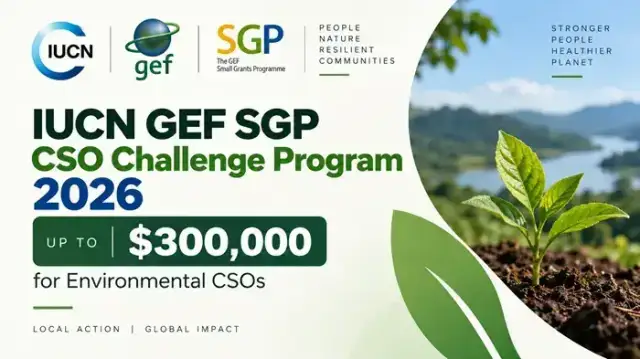
The IUCN GEF SGP CSO Challenge Program offered up to US$300,000 to scale proven environmental solutions under its regional calls.
This Ghana ICCA-GSI Phase II call provides grants of up to:
US$50,000
and has Ghana-specific eligibility and geographic priorities.
Final Takeaway
The GEF Small Grants Program Ghana 2026 offers an important funding opportunity for local organisations involved in community-led environmental conservation.
Successful applicants can receive:
Up to US$50,000.
The programme is particularly relevant to:
-
NGOs
-
Nonprofit organisations
-
Civil Society Organisations
-
Community-Based Organisations
-
Community groups
-
Qualifying social enterprises
Projects can address five major environmental areas:
Community-based conservation of threatened ecosystems and species
Sustainable agriculture, fisheries and food security
Low-carbon energy access
Chemicals and waste management
and:
Sustainable urban solutions.
The call places particular geographic emphasis on communities along the:
Black Volta Basin.
Priority areas include Wa-West, Banda, Bole, Sawla-Tuna-Kalba and Central Gonja.
Applicants should also understand that this is a:
Ghana-specific funding opportunity.
It should not be promoted as a general grant for organisations anywhere in Africa.
For organisations that qualify, timing is now critical.
Applications close:
3 October 2026 at 5:00 PM.
A virtual proposal workshop is scheduled for:
22 September 2026.
Eligible organisations should therefore review the full Call for Proposals, download the correct proposal template and prepare their application as soon as possible.
0 Comments
Be the first to comment.
Leave a comment
Replying to ·