United Nations
✓ VerifiedThe United Nations (UN) is the world's largest and most prominent intergovernmental organization — not a company, but an association of sovereign nations. It was founded on 24 October 1945, in the aftermath of the Second World War
About
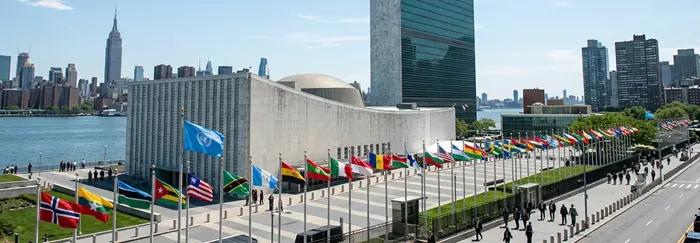
The United Nations (UN) is the world's largest and most prominent intergovernmental organization — not a company, but an association of sovereign nations. It was founded on 24 October 1945, in the aftermath of the Second World War, when 51 countries committed to a charter dedicated to maintaining international peace and security, developing friendly relations among nations, promoting social progress and better living standards, and advancing human rights. Today its membership has grown to 193 member states, encompassing nearly every recognised country on Earth.
The organization is governed by the UN Charter, an international treaty, and is built around six principal organs: the General Assembly (where all 193 members are represented), the Security Council (responsible for international peace and security, with five permanent veto-wielding members — China, France, Russia, the United Kingdom, and the United States — and ten elected members), the Economic and Social Council, the Trusteeship Council, the International Court of Justice (seated in The Hague, the only principal organ not in New York), and the Secretariat (the administrative body that carries out the day-to-day work).
The UN is led by the Secretary-General, its chief administrative officer and top diplomat. The current Secretary-General is António Guterres of Portugal, serving his second term, which ends on 31 December 2026. A selection process for the tenth Secretary-General is under way throughout 2026, with the successor expected to take office on 1 January 2027 — and a widely reported push to appoint the first-ever woman to the role.
The UN's work reaches every corner of the globe. While best known for peacekeeping, conflict prevention, and humanitarian assistance, it operates across a vast range of issues through its wider "UN System" of specialised agencies, funds, and programmes — bodies such as UNICEF, the World Food Programme (WFP), the World Health Organization (WHO), UNHCR (refugees), UNDP (development), and UNEP (environment). Its agenda spans sustainable development (anchored by the Sustainable Development Goals), climate action, disaster relief, refugee protection, disarmament, human rights, global health, and counter-terrorism. It is funded not by revenue but by assessed and voluntary contributions from member states — and, notably, in 2026 it faces significant financial strain, including large arrears owed by member states.
In short, the UN functions as a forum for dialogue, a coordinator of collective action, and an implementer of global programmes — the closest thing the world has to a central institution for international cooperation.
Open positions
1 jobCategories
Awards & recognition
- The UN and its bodies/officials have received the Nobel Peace Prize multiple times — notably UN Peacekeeping Forces (1988), the UN and Kofi Annan jointly (2001), and various agencies (e.g. UNICEF in 1965, UNHCR in 1954 and 1981, the WFP in 2020, and the IAEA, a related body, in 2005). These are genuine, verifiable and worth listing.
Branches
- UN Office at Geneva (UNOG): Palais des Nations, 1211 Geneva 10, Switzerland
- UN Office at Vienna (UNOV): Vienna International Centre, Wagramerstrasse 5, 1400 Vienna, Austria
- UN Office at Nairobi (UNON): United Nations Avenue, Gigiri, Nairobi, Kenya
- International Court of Justice: Peace Palace, The Hague, Netherlands