Forte Oil PLC (Ardova PLC)
✓ VerifiedFew corporate names capture the twists and turns of Nigeria's downstream oil industry quite like Forte Oil PLC. Over six decades, the company morphed from a subsidiary of a British multinational into an indigenous energy powerhouse
About
Few corporate names capture the twists and turns of Nigeria's downstream oil industry quite like Forte Oil PLC. Over six decades, the company morphed from a subsidiary of a British multinational into an indigenous energy powerhouse, became one of the most closely watched stocks on the Nigerian Stock Exchange under billionaire Femi Otedola, and eventually shed its identity altogether to become the company known today as Ardova Plc. This post traces that full journey — from colonial-era origins to a modern, fully integrated energy business.
Origins: British Petroleum (Nigeria), 1964
The company's story begins in 1964, when it was incorporated as British Petroleum (Nigeria), a local subsidiary of the British oil major. For its first decade and a half, it operated much like many other foreign-owned downstream businesses in Nigeria — distributing refined petroleum products in a market still dominated by multinational players.
Indigenization and the African Petroleum Era
In 1979, against the backdrop of Nigeria's indigenization policies aimed at increasing local ownership of key industries, the company changed its name to African Petroleum Limited (AP). Under this identity, it became one of Nigeria's most established fuel marketers, distributing petrol, diesel, aviation fuel, and kerosene, along with lubricants, across the country.
African Petroleum operated for over two decades under this name, gradually becoming one of the most recognizable fuel brands in Nigeria, even as ownership and management structures shifted over the years.
The Otedola Era: Zenon's Acquisition and the Forte Oil Rebrand
The most transformative chapter in the company's history began in the mid-2000s, when Nigerian businessman Femi Otedola, through his company Zenon Petroleum and Gas Limited, acquired a majority interest in African Petroleum from the Nigerian National Petroleum Corporation (NNPC). Otedola first acquired a 28.7% stake in 2005, then added a further 29.3% in December 2007 for approximately N40 billion — bringing his total holding, combined with Zenon's existing stake, to about 55.3% and giving him effective control of the company.
Otedola's entry triggered a dramatic re-rating of the company's shares: its market capitalisation reportedly climbed from around N36 billion to N217 billion within six months of his takeover, as investors reacted to the change in leadership and strategic direction.
In 2010, under new management and a three-year turnaround programme, the company rebranded once again — this time to Forte Oil PLC, the name under which it would become one of the best-performing stocks on the Nigerian Stock Exchange over the following years.
Business Operations Under Forte Oil
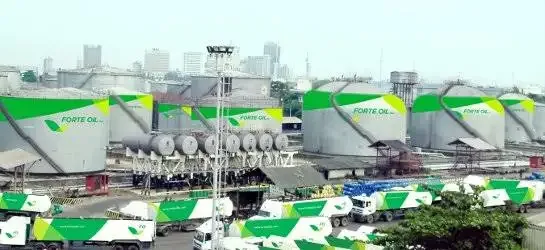
As Forte Oil, the company operated as a diversified, integrated energy business rather than a pure fuel retailer. Its operations spanned several segments:
- Fuels — distribution of Premium Motor Spirit (PMS/petrol), diesel, aviation turbine kerosene, and household kerosene to retail and industrial customers
- Lubricants and Greases — manufacturing and sale of lubricants for automobiles and industrial machinery
- Power Generation — through its interest in the 414MW Geregu power plant in Kogi State, Forte Oil extended its footprint into Nigeria's electricity generation sector, at one point signing an $83 million contract with Siemens in 2015 to upgrade the plant
- Haulage and Transportation — logistics services supporting the movement of petroleum products
- Aviation Refuelling — aircraft refuelling services at key Nigerian airports
At its peak, the Forte Oil retail network grew to hundreds of filling stations spread across Nigeria's six geopolitical zones, supplying fuel to a wide range of industrial customers as well as everyday motorists.
Financial Volatility
Like much of the downstream oil sector, Forte Oil's fortunes were closely tied to swings in global oil prices, naira exchange rates, and Nigeria's often-turbulent fuel subsidy regime. The company experienced periods of strong profitability alongside periods of significant losses — a volatility that was mirrored in dramatic swings in its share price and, by extension, in the personal net worth of its majority shareholder, Otedola, over the years.
The Sale to Ignite Investments and the Birth of Ardova
In 2019, Otedola moved to exit his position in the company, and Ignite Investments and Commodities Limited, led by Chairman Abdulwasiu Sowami, concluded the acquisition of a 74.02% equity stake in Forte Oil's downstream operations. This marked the end of the Otedola era at the company.
Following the change in ownership, the company's board proposed a resolution to change its name, and in February 2020, Forte Oil PLC officially became Ardova Plc — closing out the "Forte Oil" chapter after roughly a decade.
Ardova Plc: Consolidation and Growth
Under its new ownership and identity, Ardova pursued an aggressive consolidation strategy in Nigeria's downstream oil and gas market. A landmark move came in 2021, when Ardova announced and then completed the acquisition of a 100% equity stake in Enyo Retail and Supply Limited, a fast-growing indigenous fuel retailer. Rather than expanding station-by-station, management opted to acquire an entire network in one transaction to rapidly consolidate market share — a decision company executives later described as central to their growth strategy.
By its 60th anniversary (marking 60 years since incorporation as British Petroleum Nigeria in 1964), Ardova had positioned itself as one of the largest privately-owned, fully integrated downstream oil and gas businesses in Nigeria, with what the company describes as a "coast to home" model spanning the entire energy value chain — from product sourcing and imports to retail distribution. The company has also positioned itself as one of the largest off-takers of petrol from the Dangote Refinery, and has invested in renewable energy offerings, including solar systems, citing Nigeria's strong solar irradiation potential, particularly in the north of the country.
Ardova also continued to operate in aviation fuel supply, running joint aviation hydrants and depots in Lagos, Abuja, Port Harcourt, and Kano to service local and international airlines.
Delisting from the Nigerian Exchange
In a significant corporate development, Ardova Plc was delisted from the Nigerian Exchange (NGX) on July 26, 2023, following a voluntary buyout of the company's remaining minority shareholders by majority owner Ignite Investments & Commodities Limited. To take the company fully private, Ignite offered minority shareholders N17.38 per share — valuing their combined 25.9% holding (roughly 970.7 million shares) at about N16.9 billion. The move effectively brought to a close Forte Oil/Ardova's decades-long run as a publicly traded company on the Nigerian bourse.
Legal Disputes
The company's ownership history has not been without legal friction. A notable arbitration dispute arose over the original share purchase agreement (SPA) tied to the 2019 acquisition of Forte Oil by Ignite Investments and Commodities. The London Court of International Arbitration (LCIA) ruled on aspects of the matter, and reports indicated Femi Otedola was awarded a sum in the tens of millions of dollars in connection with the arbitration outcome — a dispute that Ardova, for its part, has publicly pushed back against in various company statements over the years.
Legacy
From its start as a British colonial-era petroleum subsidiary in 1964, through its indigenization as African Petroleum, its high-profile Otedola-led transformation into Forte Oil, and its eventual rebirth as the privately-held Ardova Plc, the company's history mirrors much of the broader story of Nigeria's downstream petroleum sector: waves of foreign divestment, indigenous ownership, stock market volatility, bold acquisitions, and — eventually — a retreat from public markets in favour of private consolidation.
Today, operating as Ardova Plc, the company remains one of Nigeria's major integrated energy players, with an extensive retail network, aviation and haulage operations, a stake in power generation, and a growing renewables business — continuing a corporate lineage now stretching back more than sixty years.
Open positions
3 jobsRetail Station Cashier (Multiple Locations)
Retail Station Manager (Multiple Locations)
LPG Station Manager (Multiple Locations)
Categories
Branches
- Main Operations Depot/terminal & Procurement Office: 1 AP/Conoil Road, Ijora, Apapa, Lagos, Nigeria
- Extended operations in Ghana: (regional presence, no single public address confirmed)
Last verified: July 3, 2026
Editorial Note: This article was researched using publicly available sources, with priority given to official sources where available. Information relating to deadlines, eligibility, funding amounts and programme requirements can change. Readers should verify current details with the relevant official organisation before applying. Read our full Editorial Policy.